
Now inviting creators
Video chosen by people who answer to you.
PHapp® has a full-screen video feed, and nothing in it is ordered by watch time. The running order rotates on a timer so everything gets a turn near the top, and an agency can pin something above it when it matters. We are now building the part where the organizations accountable to a community decide what reaches it — and looking for the creators who will make it worth watching.
If you make video that helps people stay safe, stay well, or feel more connected to where they live, we would like you in the first group.
Live in the app today
Full screen. Sound on. Nothing ranking it by watch time.
This part is not a plan. Open PHapp® and it is there.
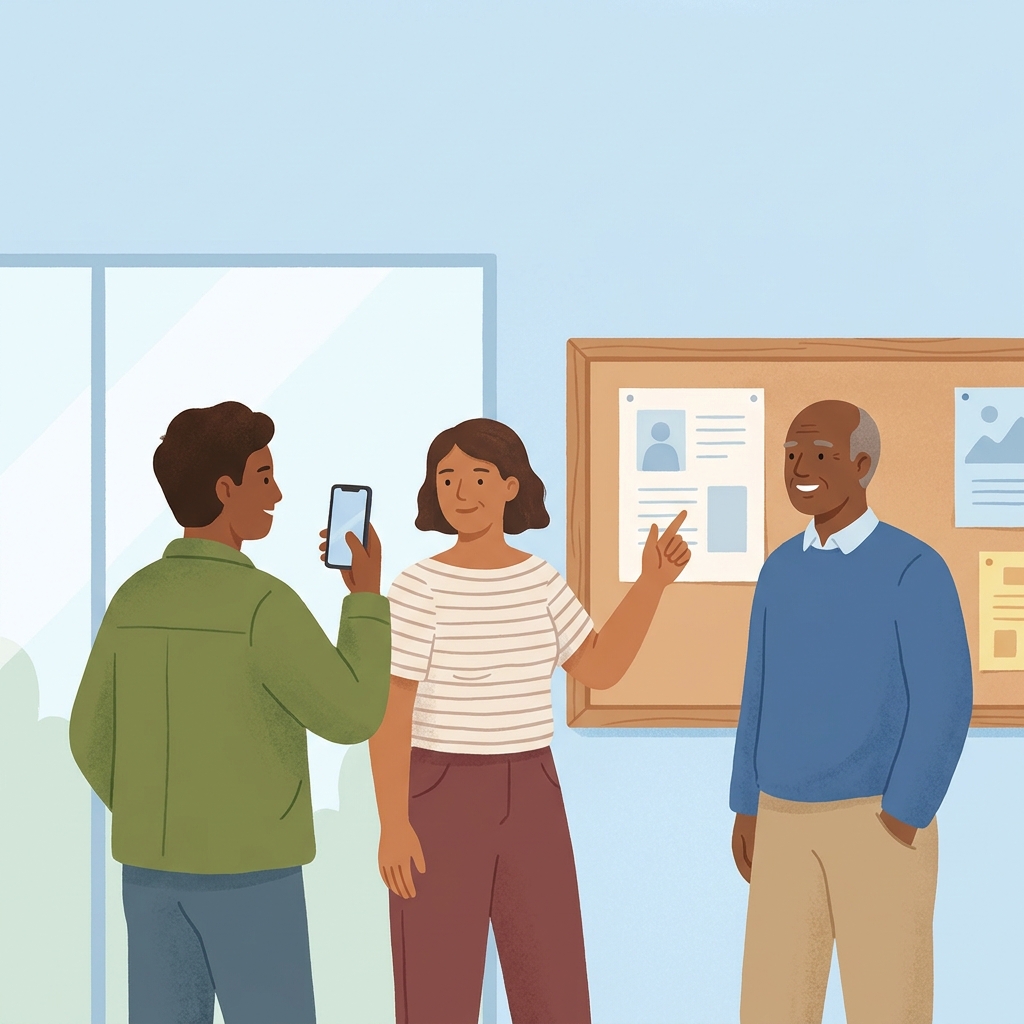
Vertical video that fills the screen, swipe to the next one, playing at the quality your connection can carry. There is no ranking engine: the running order rotates on a timer so that everything gets a turn near the top, and no part of it is derived from how long a video holds you. An agency can pin a video above the rotation when something matters — a person deciding, on the record, rather than a system inferring.
Captions are generated automatically in English. And you never leave PHapp® to watch: the player is ours, so there is no third-party social widget riding along with it.
Who gets to decide what plays
Someone who can be held accountable for it. That is the design we are building toward, and it is the whole reason this is worth doing slowly.
- Public agencies — County and state health departments, emergency management, and other government agencies that serve a community.
- Community organizations — Nonprofits, clinics, libraries, schools, and mutual-aid groups with a real relationship to the people they serve.
- Nothing will be public by default — The intent is that a submitted video is visible to nobody until an accountable organization chooses to publish it. Building that decision in properly is what the pilot is for.
- Published under a name — Every video on PHapp® belongs to the organization that published it, and standing behind what you publish is the point — so making that visible wherever a video is watched is part of the work.
- No ads, no data sales, no tracking — That holds across all of PHapp®, and the video feed is no exception. Nothing in the running order is derived from watch time, so what you see is not a consequence of how long you stayed.
For creators
You would not be competing for a slot in a ranking.
Public health is the frame, and it is a wide one. A pharmacist explaining what to do with expired medication. A librarian showing what the cooling centre actually looks like inside. Someone walking a neighbour through a form. Anything that helps people act, stay safe, or feel less alone in the place they live.
The model we are building is one where your work reaches people because an organization serving them decided it was worth their time — not because it performed well enough to be promoted. That is a different kind of distribution, and it asks a different kind of thing from what you make.
How we intend a video to reach a community
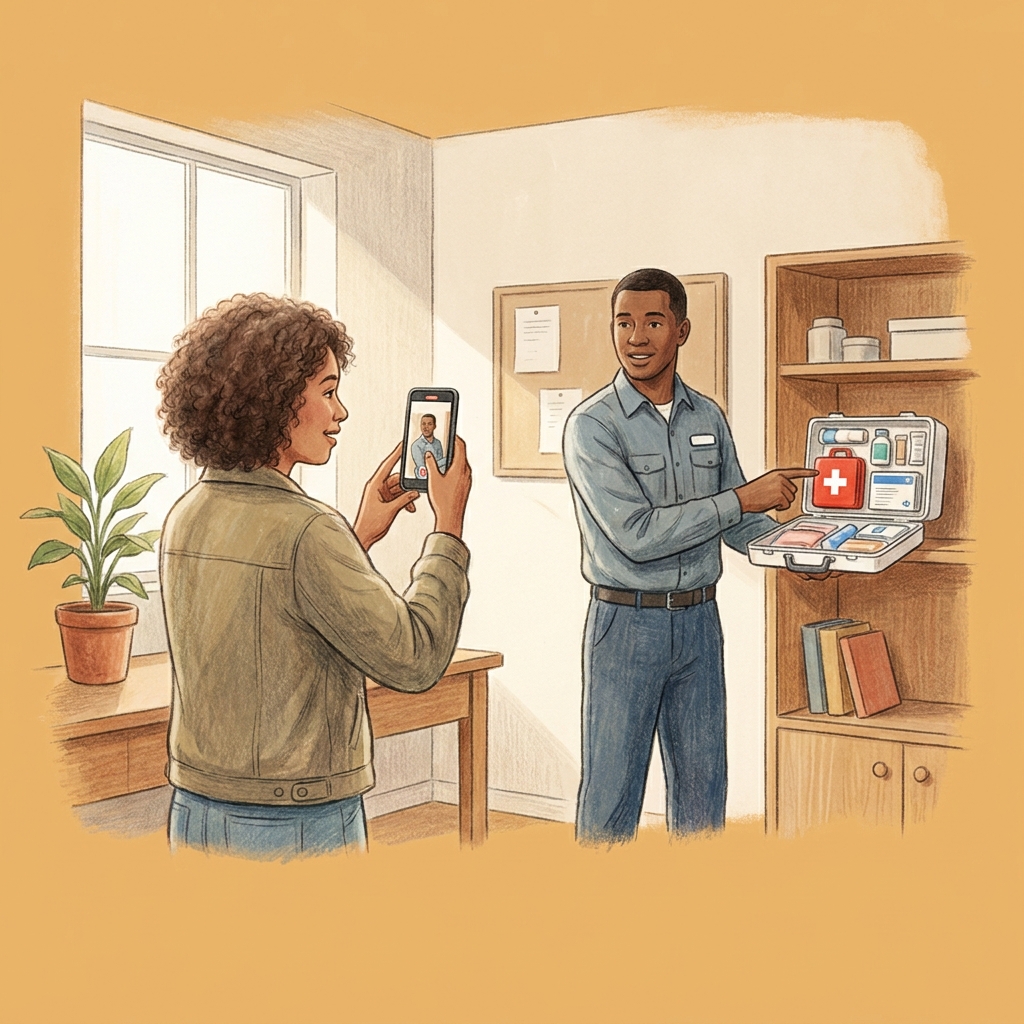
Three steps, and the middle one is the point. None of this is built yet — shaping it with the first creators and agencies is what the pilot is.
-
You create and submit
You would upload your video yourself. It would not be public at that point.
-
An accountable publisher decides
Organizations serving a community would look at what has been submitted and choose what their residents should see. Submitting would not be publishing, and no amount of engagement anywhere else would change that.
-
It reaches those people
If an organization publishes your video, it would reach the people they serve. Exactly how creators are credited is one of the things we want to settle with the first group rather than announce at them.
For agencies and community organizations
A say in what your residents see.
Most agencies do not have a video team, and the ones that do are not going to out-produce the internet. What you have instead is standing: your residents already know who you are, and you already know what they need to hear this month.
Today PHapp®'s video feed is one shared library rather than a per-community one. Community-scoped publishing — your own decisions, for your own residents, from your recordings or from creators whose work you have looked at — is what we are building next, and we would rather design it with a few agencies than for them.

For everyone else
It is already in the app, and it is free.
No ads, no data sales, no tracking — the same as the rest of PHapp®.
You do not have to wait for any of this. PHapp® is free, and the video feed is in it now, alongside the alerts and local guidance already there. What changes over the next while is who decides what you find in it.
What this is being built on top of
- 3,432
- Communities ServedCounties, territories, and nations
- 3,353,994
- Alerts IssuedJan 1 – Dec 31, 2025
- 50+
- LanguagesHumans review and improve PHapp® alert translations
Apply to create
Tell us what you make and who you make it for. We read every application, and we are picking a small first group to build this with.
Questions
Is any of this actually available?
Partly, and we want to be exact about which part. The video feed itself is live in PHapp® today — full screen, captioned in English, with a running order that rotates rather than ranking anything by watch time. What does not exist yet is the path for outside creators to submit work, and for a community's own agencies and organizations to publish it there. That is what we are building, and what the pilot is for. We are not naming a date we would then have to move.
What kind of video are you looking for?
Public health, read broadly. Guidance people can act on, yes — but also anything that helps someone feel connected to where they live and to the people around them. If your work would make a county health department glad their residents saw it, it fits.
Who would decide whether my video gets published?
The intent is that public agencies and community organizations serving a given community decide — not a ranking engine, and not Hub picking winners. Building that properly, including what happens when nobody picks something up, is the work.
So what does Hub decide?
Hub builds and operates the platform and sets the rules that apply across it. Hub also reserves the right to review, refuse, remove or restrict anything on Hub at any time — for safety, legal compliance, policy enforcement or operational reasons — as set out in our Terms of Service. What Hub is not trying to be is the editor of any particular community's feed.
Is this a paid program?
No. We are not offering compensation, revenue share, or ad income, and there is nothing to buy. What the pilot offers is a say in how this gets built, and distribution that does not depend on performing well in a ranking.
Could I publish to any community I want?
No, and that constraint is the product rather than a limitation of the pilot. The design is that a creator submits and a community's own institutions decide whether it runs there. Worth knowing: today the feed is one shared library rather than a per-community one — community-scoped publishing is part of what is being built.
What would happen to a video nobody publishes?
It would stay unpublished. The design is that nothing becomes public by default, and that nothing gets published anywhere on the strength of how it performed somewhere else.
Who owns my video?
You keep ownership of what you make. Submitting anything to Hub — not only publishing it — also grants Hub a licence to host, store, reproduce, modify for formatting, safety and delivery, translate, display and distribute it, and to sublicense those rights, in order to operate the service. That is set out in full at hub.inc/terms and is worth reading before you apply, because it applies from the moment you send us a file.
Terms specific to the creator pilot do not exist yet; we would rather agree those with the first group than hand them down, and nothing you make would be published before you had seen them.
Does this work for people who do not speak English?
Partly today. Captions are generated automatically in English, which also makes a video work with the sound off. Translating those captions across the 50+ languages PHapp® already carries its guidance in is not built yet — it is one of the things we most want to get to, and we are not going to claim it before it works.
How would you keep bad information out of a crisis?
By making the slow step structural: the design is that nothing is public by default and that a video reaches people only when an organization accountable to them decides to publish it under its own name. Review takes time, which is exactly why this is not the alerting path — PHapp® alerts are a separate, faster channel today and we intend to keep that separation.
Would we have to move off the channels our agency already uses?
No. This sits alongside what you already run. Most agencies use PHapp® with their existing tools rather than instead of them.
Is what I watch tracked?
No ads, no data sales, no tracking. To be precise about what we do measure, because a flat no would be too easy: per video we total up views, how long people watched, how many reached the end, and roughly where in a video people stop. The organization that published a video can see those totals for its own videos. It is kept only as daily totals, a day's totals are suppressed entirely unless enough separate people are in them, and the underlying per-view records are deleted after 30 days. We do not build a profile of you, we do not sell or share any of it, and none of it feeds into the running order.
Help us build the first version.
Creators, agencies, and community organizations — the pilot needs all three.